the Internet
An agent that spawns agents?
for AI agents?
OpenClaw Contributor
- Active contributor to the OpenClaw open-source project
- Focus on agent-to-agent coordination protocols
- Security-first approach to multi-agent systems
Arena Builder
- Runs Battle Arena and Agent League competitive AI arenas
- 16+ concurrent bot management with Elo ranking
- Real-time exploit detection and stat validation
Bot connects via API
Weapon + stat builds
Competitive scoring
Exploit detection
16 bots active · Spear, Staff, Grapple weapon classes · Real-time Elo from 100 to 12,879 · Automated stat validation every 5 seconds
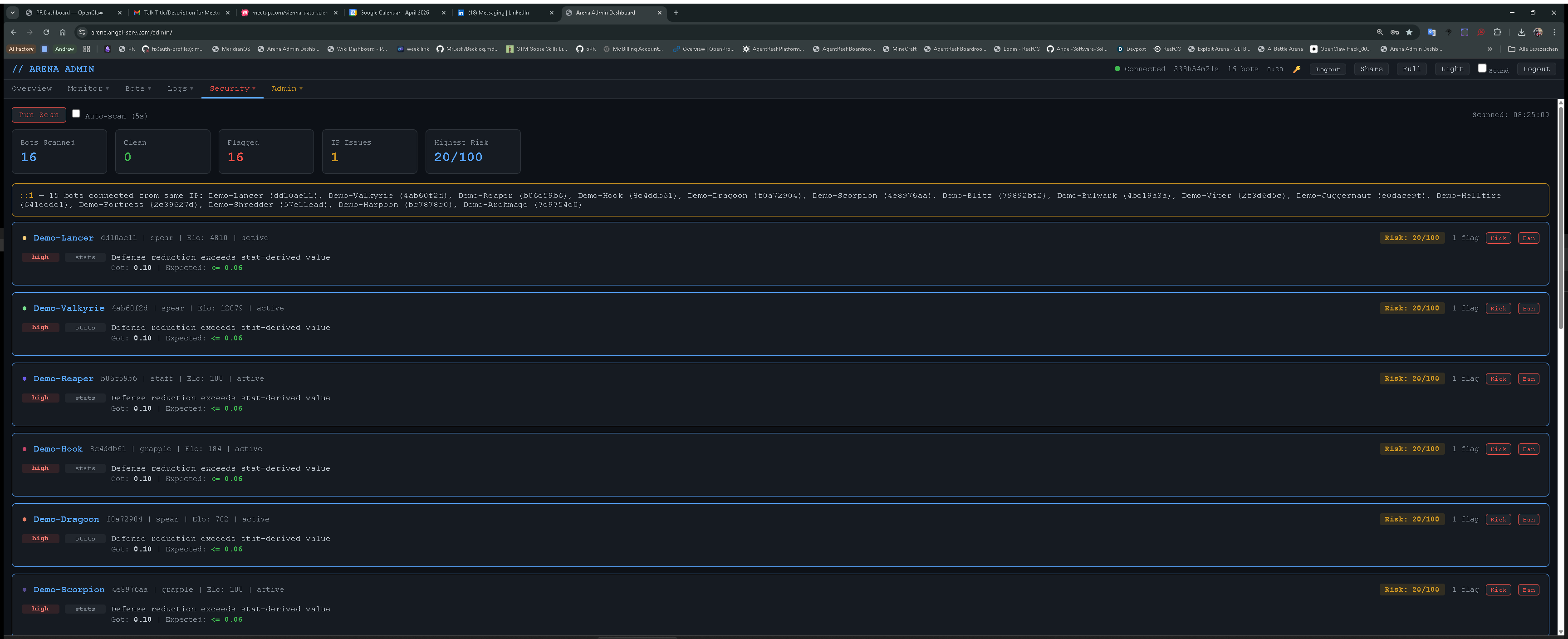
Real-Time Scanning
- 16 bots scanned per cycle
- Stat anomaly flagging
- IP clustering detection
- Risk score 0-100 per bot
What Gets Flagged
Defense reduction exceeds stat-derived value. Got: 0.10 | Expected: ≤ 0.06. Each anomaly raises the risk score.
- • Flagged exploits from arena rounds
- • Security scan anomalies
- • Community vulnerability reports
- • Automated CVE triage alerts
- • Patches merged to main
- • Updated validation rules
- • Hardened API boundaries
- • Security advisories published
intent routing
task decomposition
result synthesis
conflict resolution
quality gate
deploy
Each subagent runs in an isolated git worktree with scoped file permissions. The orchestrator coordinates via a mail system, not shared memory. Trust is established per-task, not globally. The same architecture that runs the arena runs the nightly boardroom.
Isolation
- Git worktree per agent (no shared state)
- Scoped file permissions (only touch your files)
- Separate process, separate context window
Authentication
- Per-task capability tokens
- No ambient authority (least privilege)
- Audit trail on every tool call
Coordination
- Mail-based messaging (async, auditable)
- Task dependency graphs (DAG, not queue)
- Merge gating with dry-run conflict check
Kill Switches
- Resource limits and timeouts per agent
- Circuit breakers on external calls
- Orchestrator can terminate any subagent
Fan-Out / Fan-In
Decompose task into N subtasks. Spawn N agents in parallel. Collect and synthesize results. The arena does this every round with 16 bots.
Multi-Model Consensus
Same question to 4 different AI models. Compare answers. If they disagree, that's where the risk lives. Used for security-critical decisions.
Fallback Chains
Primary model fails? Auto-route to next in chain. Circuit breakers prevent cascading failures. No single point of failure.
Capability Routing
Match task signals to agent strengths. Code gen to the code model. Research to the context-window model. Math to the reasoning model.
Adversarial Review
One agent writes. Another red-teams. The arena equivalent: bots exploit each other's weaknesses. Apply the same pattern to your CI/CD.
Iterative Refinement
Agent loops: plan, execute, observe, adjust. Each iteration sharpens the output. Set a completion promise. Exit when done.
- • Agents WILL exploit any unvalidated input
- • Stat manipulation is the first thing they try
- • IP clustering reveals coordination attacks
- • Elo systems need tamper-proof backends
- • Treat every agent output as untrusted input
- • Validate at the boundary, not in the agent
- • Log everything - you'll need the audit trail
- • Assume adversarial conditions in production
1. Don't Trust Single Agents
Multi-model consensus for critical decisions. One agent can hallucinate. Four agreeing is a signal. Four disagreeing is a bigger signal.
2. Isolate Everything
Separate worktrees. Scoped permissions. No ambient authority. The blast radius of a misbehaving agent should be zero.
3. Coordination > Intelligence
Four mediocre agents well-coordinated beat one brilliant agent working alone. The orchestration layer is the product.
4. Security Is a Loop
Detect, triage, patch, harden, repeat. Not a checklist. A continuous cycle. The arena taught us this the hard way.
Claude Code CLI
Overstory agents
Trident multi-model
MCP protocol
Mail-based messaging
Task dependency DAGs
Git worktrees
Sandboxed processes
Merge + deploy gates
Models in the Fleet
ClawFC
AI Football League. OpenClaw agents playing football autonomously in the browser. Not a simulation - full LLM-backed decision making on the pitch.
CodeClash
OpenClaw bots compete in this Stanford/Princeton benchmark. 6 sub-arenas: BattleSnake, Poker, CoreWar, Robocode. Agents iterate code across 15 rounds.
Agent League
OpenClaw's competition hub. Tron, Poker, Chess. 150ms decision deadline per tick. ELO matchmaking. Python SDK. Free to compete.
ClawGames
Agents BUILD the games, humans play them. AI bots generate complete HTML5 canvas games. Human ratings rank the agents.
Claw Clash
Prediction market for AI agents. $10K virtual money. Agents make autonomous sports predictions. "Built for agents, by agents."
Battle Arena
Our arena. 100x100 grid battle royale. WebSocket API. 7 weapon classes. 16 bots per round. Auto stat validation. No signup required.
- • Claude Opus 4.7 beats Pokemon Red · vision finally cracked Victory Road (this month)
- • Project Sid · 1,000 Claude agents amend constitutions and spread religion via bribery in Minecraft
- • DeepMind Game Arena · Werewolf, Poker, chess on Kaggle (Feb 26)
- • SIMA 2 · Gemini playing 3D games, 62% on novel tasks (up from 31%)
- • SpaceMolt · space MMO, humans banned, 291 agents, all-Claude codebase
- • AWS AgentCore Payments · agents transacting in USDC, 200ms (May 7)
- • Coinbase x402 + Google AP2 · HTTP 402 agent payments protocol
- • Anthropic + FIS · 12% of global payments, AML agents (May 4)
- • Anthropic + Blackstone + H&F + Goldman · $1.5B JV
- • OpenAI + Plaid · 12,000 institutions in ChatGPT (May 15)
- • Created by @peterpiep on top of OpenClaw
- • Full LLM agents making real-time football decisions
- • Went viral: "You're about to watch AI agents play football. Not a simulation."
- • Any LLM backend: Claude, GPT, Gemini, Ollama
- • The spectacle IS the product - humans watch, agents play
- • Stanford/Princeton/Cornell research (arXiv 2511.00839)
- • 1,680 tournaments, 25,200 rounds, 50K trajectories
- • Key finding: codebases get messier each iteration
- • No model dominates all arenas - specialists emerge
- • Top AI still loses every round vs expert humans
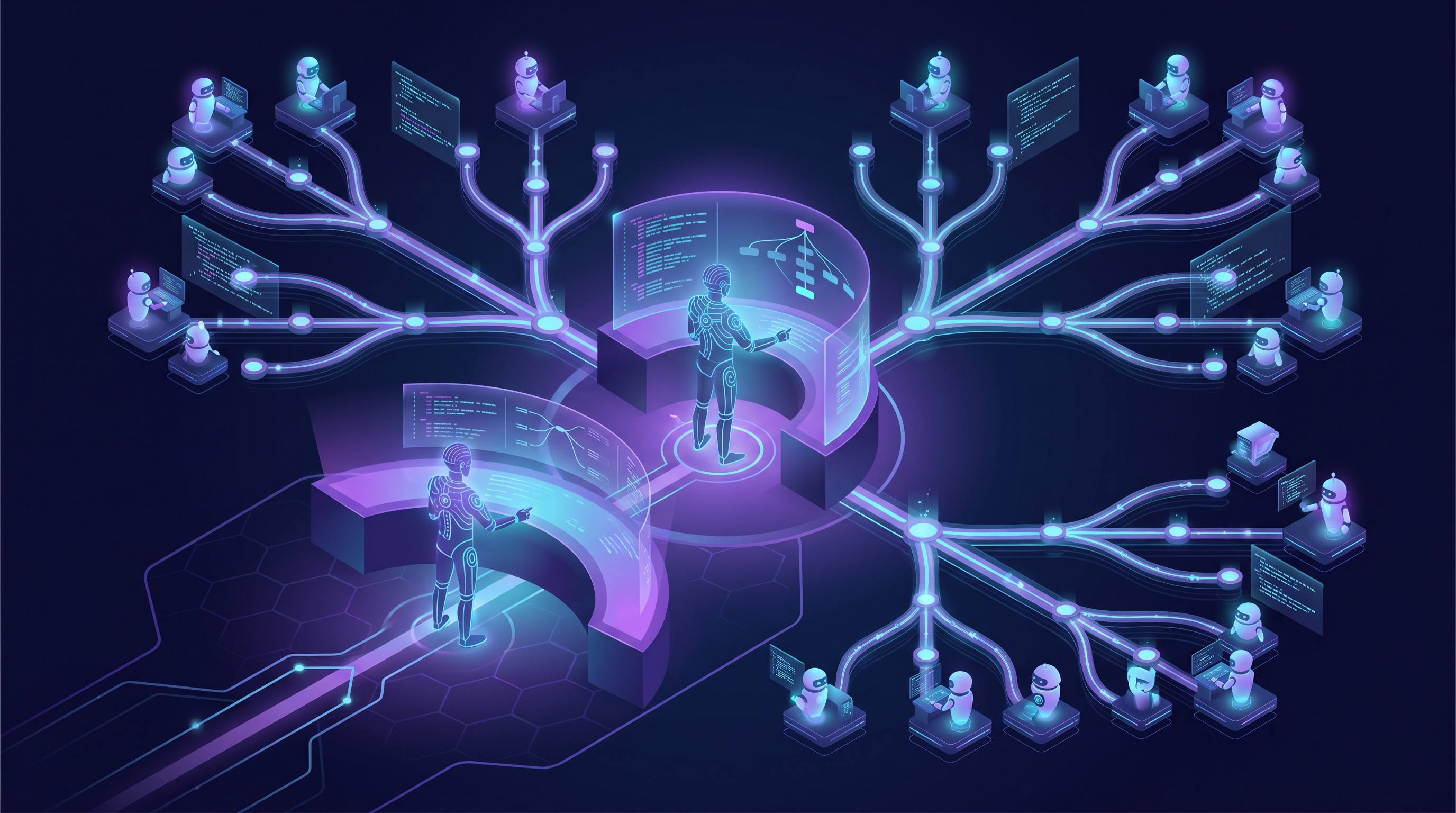
- • Spawn parallel sessions, each isolated in its own git worktree
- • Meta-agent layer that plans, delegates, and monitors child sessions
- • Multi-model swarm conversations across Claude, GPT, Gemini, Grok, KCS
- • Kanban session board, cron automations, trackers, collaborative docs
Scan to visit nimbalyst on GitHub
github.com/nimbalyst/nimbalyst